Wednesday, September 25, 2013
Time sinks
Deep sadness, overstruck by deeper strength
Union Officer describing Robt. E Lee at Appomattox Courthouse
After a rather disappointing last show, I decided that maybe I needed little more modern chair. After all, not everyone lives in an old farmhouse. So to that end I decided to come up with a modern chair that could be easily built in lots of 6 or 8. I had designed a small side chair years ago for a potential client that never panned out so I decided to dust that off and make one up. Above you can see the original quick and dirty prototype. And below the side view.
I thought that a bent lamination would be the strongest way to make a bent back leg so I did that and broke the leg as I tried to glue it up. So I steamed more pieces and bent them, and then did up a bent lam. Tick tock.
More views of the time consuming glue up. I do have a vacuum bag that works great but still. Its a messy time consuming process.
Below you can see exactly how far I got with this chair. The seat and back are more bent laminations. The back legs have to be fit with a plane because each back is different. Each leg comes out a little different and has to be fitted. The seat pan has to be shaved to fit the rails. Long process.
What I'm coming at with post is this. As a professional chair maker I have to make every minute count. I can't spend oodles of time on chairs or designs that I know will never pan out. This chair will never look better than a $40 buck garage sale chair. And I know that. There comes a time in every design or build where you really have to think where is this going. And where will it end? What will the end product be? Some designs are just dead ends. Time lost but lesson learned.
Some things you do are just dead ends...times sinks that will never go anywhere and you have to cut them loose or they will drag you down.
Sunday, September 15, 2013
Hints for Turning
I only that summer sang in me a little while,
that sings in me no more
Edna St. Vincent Millay
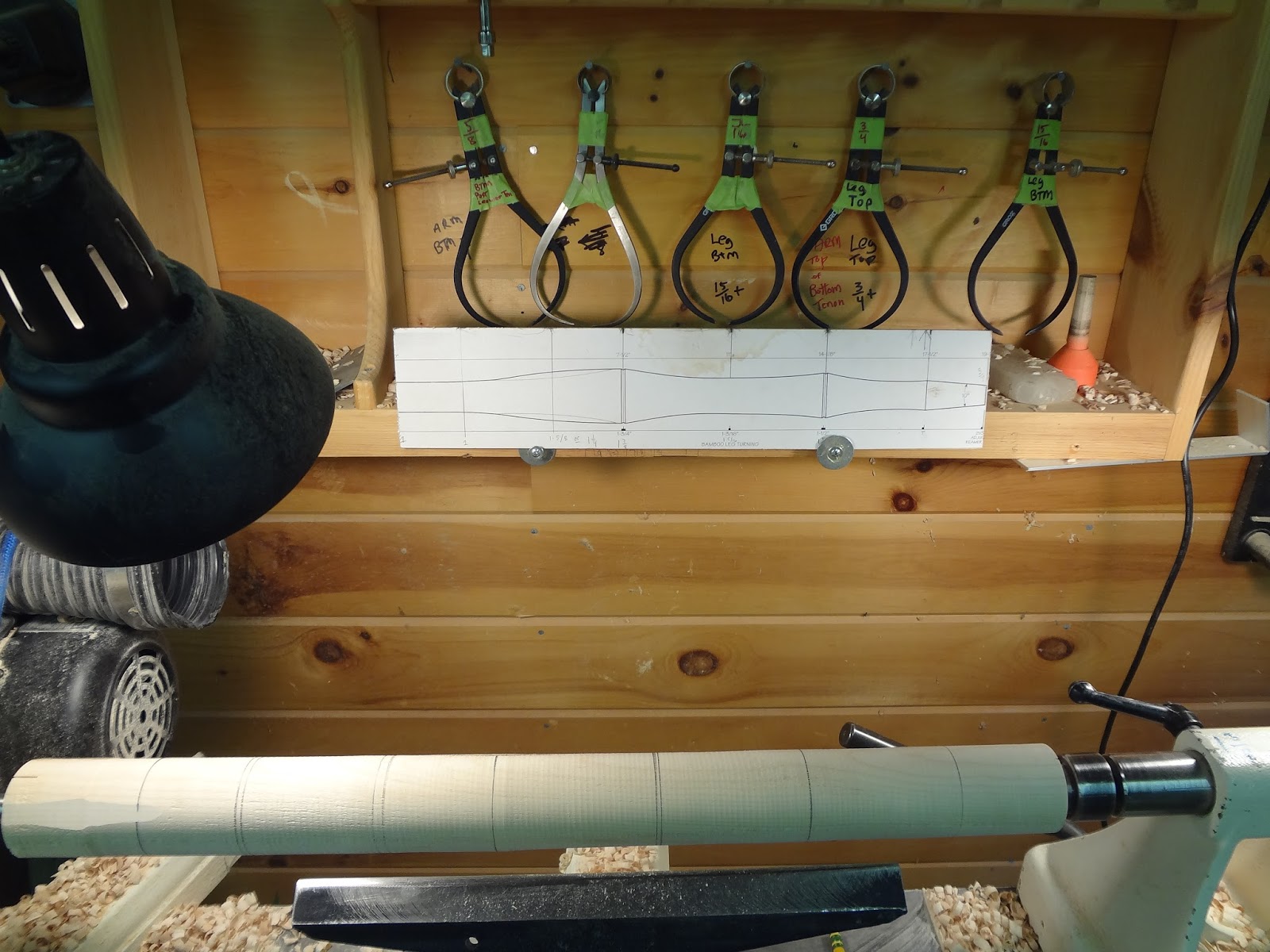
Above you can see the basic set-up I use for turning. Nothing really special here but I do want to mention a few things that have helped me out. First off I print or draw the pattern onto the a piece of thin plywood or wood and clearly mark all major and minor dimensions onto that. That way they are clearly and consistently transferred to the piece. No fiddling with a tape measure or piece of paper.
As to the major/minor dimensions. I define major dimensions as "outside" dimensions, like the outside node of a bamboo turning, or the dimension of a tenon. These are finite dimensions and are carefully measured with calipers. Further, these are denoted with with one pencil line. The "minor" dimensions represent, in this instance, the hollow between the nodes of this turning. These are also measured and cut with a parting tool as well, but when I come to actually turn them, as long as it looks good and flows it's fine. I denote these with two lines. This is all pretty obvious stuff but it really does help with consistency.
This next step was a major step forward for me. I used to struggle with vibration, even on big pieces. And while it was very obvious now, I used to simply place the blank on the lathe and use the tail stock to force the drive center into the piece. Which of course put a lot of pressure on the ends and as the middle was cut away, vibration resulted.
Now I either hammer the drive center into the end or if the blank is square I make diagonal cuts on the drive end that the drive center can bite into, and then as I'm turning the piece I can back the pressure of the tail stock and reduce the chance of vibration.
Above is a view of the a bamboo turning that shows what I mean by major and minor measures. The hills are the major dimensions and and the valleys are the minor ones.
This is a shot of the calipers I use. I used to only have a couple and I would measure each dimension and transfer to the piece. And I can tell you if you want a slow, inconsistent way to do it that's one. I also use a Galbert Caliper which works great. But for really precise measures I prefer calipers. You can't tell but I actually froze the thumb nuts with some super glue so they would not get out of whack.
Like I said, just a couple hints that have helped me out. Now off to pick blueberries with the kids!
Saturday, September 7, 2013
More Chair Seats
Any idiot can handle a crisis, it's day to day living that wears you out
Anton Chekov
It's always difficult, very difficult to predict what chairs will sell. I like Windsors and while they will always be my favorites, I remember thinking as I was loading for the last show, wow, that's a lot of black chairs. I like milk paint and the different colors and effects you can achieve with it. That having been said, I think I should add some different styles with a clear finish to my line of chairs. Maybe something more "machine" based than all hand tools. Again, I like using hand tools but classic Windsors may not fit every taste, budget or house. Long story short, I'm trying to add some chairs that are maybe less expensive and ones that can be easily built in batches of 4 or 6 or more.
Its important when doing batch runs that the machines ( table saw, jointer, bandsaw etc..) all be set up very carefully and all the pieces all be exactly the same size. If you start adding variances to the pieces, all economy of scale is lost.
Another thing I decided was that obviously the seats cannot be hand carved. So for this chair design I decided to make a form and then vacuum press the 1/8" pieces to the contour I wanted. What would be ideal is if the local veneer mill would sell me full size 4x8 sheets of 3/16" veneer. Then, no glue seams and I could run the seat grain left to right, which would match the grain in the back pieces. But until I look into that, I simply re sawed some pieces, maple in this case, to a strong 1/8" and drum sanded them and glued them up using my press. I got my bags and pipe seals and the press seen below from Veneer Supplies. The vacuum press works great and all you need is a compressor. Best part is there's a valve that keeps the vacuum constant at about -28 hg. I used a hand pump one before but it would always lose the vacuum.
Below you can see the chair prototype, a pretty simple side chair. I hope it works to be a comfortable and visually interesting chair. I further hope it doesn't look a chair you got at a garage sale for 20 bucks. Time will tell.
Here is the prototype with the pressed seat. The seat came out plenty strong even though it's only 1/2" thick.
The legs are going to be bent lamination as well. I actually had to steam them first, then bend them, then let them dry some, and then I did another vacuum press but more on that later.
Wednesday, September 4, 2013
Chair Seat
Experience is simply the name we give our mistakes.
Oscar Wilde
Used to be I would leave the sightlines and the different scribblings that comprise a chair on the bottom. Never really gave it much thought. No one ever saw it and it wasn't painted so what's the big deal. But lately, not really sure why, but this struck me as something of a short cut...lazy maybe. So I have been planing the bottoms just before assembly.
Also I now use a clean rag when I wipe the finish on the bottom of the seat. What happens is by the time you get around to wiping the oil the milk paint has been sanded three or more times, so a lot of color gets transferred to the seat in the oil. I know this is being very persnickety but it bugs me. I like to flip the chair over and see a bright, clean surface.
Here are some different shots of a seat I recently made for a rocker. I actually timed myself and came in at just over an hour, not bad.
This is a nice curl of end grain. The above drawknife is made by, I think, Ray Larson. I takes a wicked edge but due to the very low angle is really only good for pine and butternut. But even so, a small price to pay for a tool that cuts like this one.
And believe it or not this girl starts 3rd grade tomorrow...tempus fugit.
Sunday, July 21, 2013
Lining Up Posts
A divorce is like an amputation: you survive it, but there's less of you
Margaret Atwood
I knew it had been awhile since I had last posted and but April 17? Wow. See above quote. Anyway, I have a student coming tomorrow and it's high time to get back at it.
This post is about how I line up and ream the arm posts. I'm sure there are other ways but this is how I do it. If you've followed this blog at all you know I use sightlines and a square and a reamer from Elia Bizzari to obtain a 6 degree hole. Just be careful not to over-ream and all is good. But in order to get the ends to land at exactly the same place, I use winding sticks.
You can see here the side view. These arms are spot on. And the process is dead simple. I use the back of a yardstick painted green and a length of aluminum angle. The yard stick butts against the back of the posts and the aluminum angle rests over the ends of the arms. Then just sight down and you can see how the posts relate to each other.
This one is pretty much spot on. One caveat...this does not show you slope ( the angle left and right relative to the seat ) so be careful not to get tunnel vision. In other words, keep checking the reamer tip against the square. But this is a eazy-peezy way to have both the post land at exactly the same spot.
Below you can see my fancy winding sticks. I also use this same method when reaming the back posts on my rockers. Works great there too because the angle is really irrelevant ( within reason). Symmetry is much more important.
For those of you who merely read my blog for the literary wit, winding sticks ( like wind up for a pitch ) are use to flatten wood and show relations across distances. Think of it this way...if you had a black stick and a white stick, both strait and flat. And you placed them at either end of a table that was also flat. And you peered ( sited) from end to end across the table you would see a white line and a black line parallel to each other. This would tell you that the table was flat. Now imagine one end of one stick you placed three quarters under. When you sighed down the table, the sticks would be "out of wind". Now imagine that there were no quarters but the sticks were not parallel. This would tell you that the table was not flat.
Subscribe to:
Posts (Atom)