Saturday, October 27, 2012

Dina-Sailboat


She was Papa’s one true love. 

Beyond the 11 novels, through three wives, the big-game safaris in Africa, the bullfights in Spain, and the drinking, carousing and his swaggering public image, Ernest Hemingway’s beloved Pilar was the one constant of his life.


At age 71, Pilar is still waiting. Beached on concrete blocks on a hillside overlooking Havana and the blue sea, Hemingway’s 38-foot fishing cruiser sits under a corrugated metal awning on display at the author’s former Cuban estate, Finca Vigio.


Quite a bit of Hemingway’s inner and outer life transpired on the boat he owned for 27 years. It is where he wrote, read, slept, chased giant marlin, tuna and German u-boats in the Gulf Stream off of Cuba. Here he entertained celebrities, authors, navy brass, seduced women and spent time with his three sons. On her decks he also hurled hostile curses at his critics, punched out once good friends and eventually realized his writing skills were fading away. He killed himself in July 1961.


“Hemingway’s Boat: Everything He Loved and Lost, 1934-1961” (Knopf),  Paul Hendrickson


Well here she is, finished at long last,  Dina, a 12' 6" boat for sail or row... May she have fair winds and following seas.


Tuesday, October 16, 2012

Fall Clean Up


He piled upon the whale's white hump the sum of all the general rage and hate felt by his whole race from Adam down; and then, as if his chest had been a mortar, he burst his hot heart's shell upon it.

Herman Melville, Moby Dick


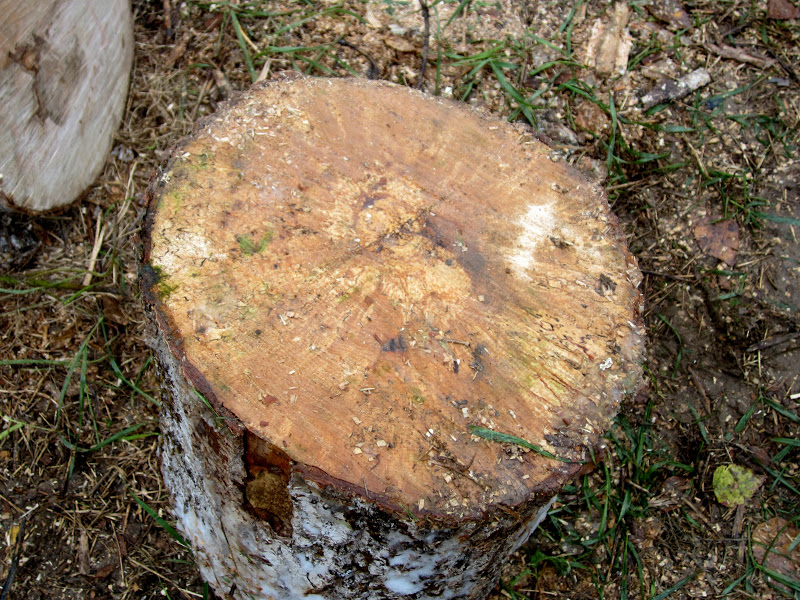
Every year, come fall, I end up with a few logs, ash and maple, that have been around for awhile and something has to be done.  So this last Sunday I decided to was the day.  Some of the logs are in pretty good shape, like this one below.  The cut looks fine, no visible rot at all.  One cool thing you can see to the left center is the head of an ingrown knot, a fist sized ball of bark that deforms a large portion of the log.


Below you can see obvious rot, usually the end of the logs.  It's fine for firewood, and splits pretty well, but is still hard work.  It really makes you realize how hard a life people lived 100 years ago, before wood splitters and chainsaws.


The white ash log below is beautiful...exactly what I am looking for... a centered heart on both ends, wide growth rings, no visible whorls or ingrown branches.  A perfect log.  One problem with ash is that it has a very low initial moisture content, so after sitting around for awhile it dries out and gets hard to work with a draw knife.  It used to fight thru but now I just turn it into firewood.


These are a few brown ash trees that I cut for a chair that never panned out.  The logs are fine, and I cut them off my land, so I'm gonna take a chance on these ones.


And here is the result.  The pieces on the tailgate are gonna be turned (literally) into legs and the rest is firewood.  Not a bad haul...now I have to go get a few more ash and maple logs to get thru the winter.  There is plenty of maple around, but the ash is a little harder to find. 


Stacked and ready for winter.


A beautiful Sugar Maple on my land, same tree I use for the legs.


Tuesday, October 9, 2012

New Chair and Fall Colors


“We are torn between nostalgia for the familiar and an urge for the foreign and strange. As often as not, we are homesick most for the places we have never known.”

--Carson McCullers


Here is my latest chair, a Comb Back with a built up rail and a shield seat rather than an oval seat.
I got the wood for the turning from a piece of maple destined for the firewood pile and it was a really sweet log.


Here you can see the built up arm.  The arm is 1 1/8" thick and 7/8" wide, which makes it a tough bend.   A strap (yes I use a strap) helps to give a little extra torque.  The arm portion is then cut away and scraped smooth.  Finally the little cove you see is chopped out.


Above you can see the seat and arms, and the carved knuckles, as well as the swelled spindles.


The carved ear and knuckle. 


Finally took some time to go for a hike with my daughter.  The leaves are just a little past peak, but there is still plenty of color.


We climbed Haystack Mountain located in Mapleton, about 5 miles from my house.  It's a short hike to some fantastic views.  The rangers have done a great job making the trail more accessible, putting in these cool stairs with rocks.


Almost to the top..


View looking south at Squapan Mountain with Squapan Lake to the right.


Below is the view south-west with Mt. Katahdin just left of center, the northern terminus on the Appalachian Trail.  Katahdin is tough, long climb so for now we'll stick to Haystack.  As I said, the leaves are a little past peak, but even so the views are incredible around this neck of the woods.


Friday, September 7, 2012

Light a Candle

“Do I contradict myself? Very well, then, I contradict myself; I am large -- I contain multitudes.”

Walt Whitman


Here is the indoor picture of my newest chair,  it is so comfortable, but hopefully it will be gone.  I will miss it but I can always make more.


Ok, this blog post is about change, changing the tools and the things that you have around you that you gripe about but live with.  Light a candle instead of cursing the darkness, all that.  Well, after much griping about this riving brake, I finally added about 6" to the top, as you can see.  I just scabbed on some scrap 2X's and drilled some holes for the pipes, and what a difference.  I found the other set up too low ( sorry Pete ) and this made a world of difference.


The above and below pics show changes I made to the handle of some tools.  The above pic shows a couple lathe gouges that I cut the handles off.  The problem was rolling from left to right, the handle (it used to be as long as the top one) hit my body, so chop and what a difference.  And in turning, I need all help I can get!
The below pic shows how I shortened the handles on my chisels.  Used to be, 100 years ago, chisel handles were graduated with the size of the chisel, small chisel, small handle.  That was then, this is now...now being one size fits all.  By cutting off about an inch and a quarter, it really improved the balance of the chisel.
 

And finally a pic of the darkness that started the flurry of change.  The scorp shown below ( I use this to shape the seats ) is pretty old, probably 10 years, and it came with the crudely shaped handles that I love!  All about function, no finish, perfect.  Then I bought Barr's drawknife and it came with these handles, which I hated but lived with for too long.  They are shaped all wrong and  the finish is slick, so finally I got a little upset, ok, mad, and made some new ones, just like the clunky old ones that work perfectly.  They work great, a lot more grip and to me they just look right.

  So, don't be afraid to change a handle here or a riving brake there, or whatever else you are cursing in the darkness.


Tuesday, August 28, 2012

Carving the Arms


Nowadays people know the price of everything and the value of nothing.

Oscar Wilde


Here is a great shot of the arm on my newest chair.  This is the trickiest part, by far.  The trick, or skill, is to get the arris, the edge where the flat falls off,  the same on both arms.   I like it to form a gentle curve, just like this one.  Below you can see how I leave the tool marks on the end and also on the underneath. 


People are amazed to find out that I use a drawknife and spokeshave to shape the arms, that's it.  I draw reference lines on both arms, just guessing on what will look good.  I do both arms at the same time,  so hopefully they will be the same. 


Then, holding the arm in my shavehorse, I carve to the lines, and then blend the high points to get it smooth.  I want the top part flat, so I finish up with a spokeshave and a bit of sandpaper.


Here is the tenon that goes thru the back post.  It is a stepped tenon, 7/8" for about 1/4" and then 3/8" all the way thru.  This tenon is turned on the lathe, which is pretty exciting as it is an offset turning.


Below you can see the tools I use.  The big thing is to keep the arms the same, constantly checking one against the other.  They really are hard to do  but they add so much visual impact to the chairs that they are well worth it.